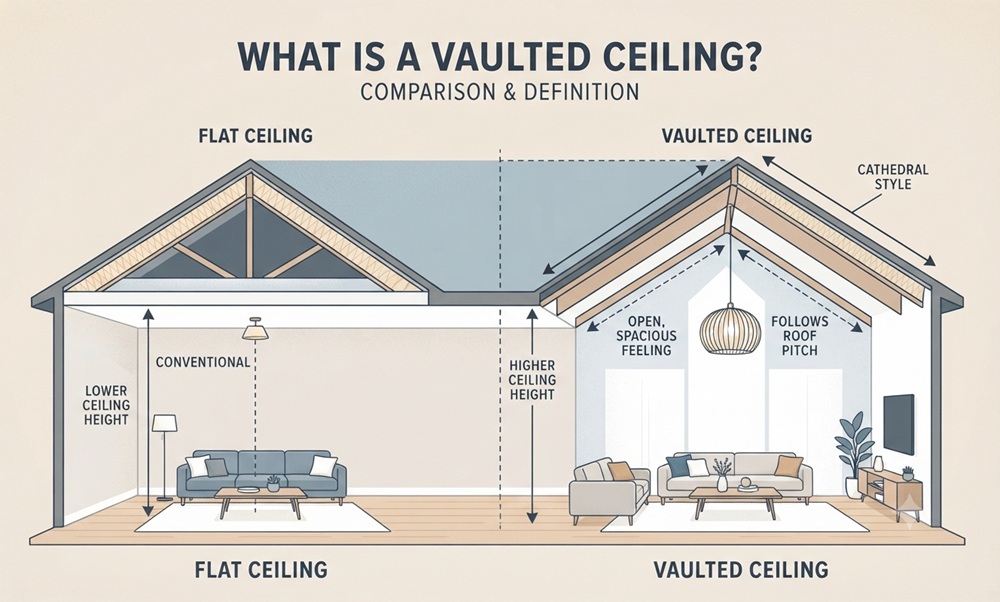
A vaulted ceiling is a ceiling that rises above the flat, level plane of a standard room and slopes or curves upward, giving the space far more height than the usual eight or nine feet. In most houses the ceiling follows the pitch of the roof, so the room opens toward a peak instead of stopping at a flat surface stretched across the walls.
The phrase covers a lot of ground, which is where much of the confusion comes from. Cathedral, barrel, groin, and scissor ceilings all count as vaulted, and each one changes how a room looks, feels, and gets built. Below you’ll find how these ceilings work, the main types, what they do well, and what to think through before choosing one.
How a Vaulted Ceiling Is Built
In a typical house, flat ceiling joists span the walls and sit beneath an attic. A vaulted ceiling skips that layer. The rafters or trusses that shape the roof stay open on the underside, and the finished ceiling follows their angle upward.
Without an attic floor tying the walls together, the framing has to resist outward pressure on its own. Builders handle this with structural ridge beams, collar ties, engineered lumber, or exposed timbers that carry the load. It’s one reason vaulted rooms are planned early rather than added on a whim.
In strict architectural terms, a vault is an arched structure, like the stone ceilings in old churches and cellars. Residential building has relaxed the word, and today it usually means any ceiling with extra height and a sloped or curved profile.
The Main Types of Vaulted Ceilings
Cathedral Ceilings
Two sloped sides rise from opposite walls and meet at a central ridge, and the slopes generally mirror the roof pitch. This is the shape most people picture when they hear the term. Some builders reserve “cathedral” for steeper, more dramatic pitches, while others apply it to any symmetrical peak, so it’s worth asking a contractor how they’re using the word.
Barrel Vaults
A barrel vault curves like the inside of a half cylinder. The look is soft and traditional, and it works well in hallways, entries, and kitchens where a full peak would feel like too much. Curved framing and plaster or drywall finishing take more labor than flat planes, so these ceilings usually cost more per square foot of surface.
Groin Vaults
Two barrel vaults crossing at right angles create a groin vault, with sharp diagonal ridges where the curves meet. The shape is historic and formal. In homes it tends to appear in entry halls, wine cellars, and covered walkways, since the geometry is demanding and the effect is strong.
Scissor Ceilings
Scissor trusses cross each other like the blades of open scissors, so the ceiling rises at a steeper angle than the roof outside. That lets a home with a modest roofline still have a tall, airy interior. It’s a clever fix when the exterior pitch is limited by style or local rules.
Single Slope Ceilings
The ceiling rises in one direction, much like a shed roof. This shape shows up in modern homes and in additions, where one tall wall can hold a big run of windows.
Vaulted Ceiling Types at a Glance
| Type | Shape | Where it often appears |
|---|---|---|
| Cathedral | Two slopes meeting at a ridge | Great rooms, living rooms, bedrooms |
| Barrel | Smooth, continuous curve | Hallways, entries, kitchens |
| Groin | Two crossing curves | Foyers, cellars, formal spaces |
| Scissor | Crossing trusses with a steeper interior slope | Homes with a modest roof pitch |
| Single slope | One rising plane | Modern homes and additions |
What a Vaulted Ceiling Does for a Room
The biggest effect is the sense of space. Extra height makes a modest floor plan feel generous, and it gives the eye somewhere to travel. A living room with the same square footage as its neighbor can feel noticeably larger once the ceiling lifts.
Height also changes how light behaves. Tall walls make room for clerestory windows, gable end glass, or skylights, which bring daylight deeper into the house. Rooms with these features often need less lamp light during the day.
There’s a design payoff too. A vaulted ceiling becomes a feature on its own, particularly with exposed beams, wood planks, or a painted finish that contrasts with the walls. You don’t need much decoration when the architecture is doing the talking.
Drawbacks Worth Weighing
Vaulted ceilings aren’t for everyone. A few downsides come up again and again.
- Heating and cooling can be harder, because warm air rises into the peak and can leave the occupied zone cooler in winter.
- Construction usually costs more than a flat ceiling because of the framing, finishing, and engineering involved.
- Painting, dusting, and changing bulbs near the peak may require scaffolding or a tall ladder, and sometimes a professional.
- Sound can echo in rooms with hard surfaces, which is noticeable in open plan living areas.
- There’s no attic above that part of the house, so you lose storage and a convenient route for wiring and ductwork.
Insulation, Airflow, and Comfort
Because there’s no attic space above, insulation has to fit inside the roof structure itself. That calls for careful detailing, including proper ventilation of the roof assembly so moisture doesn’t collect and cause problems over time. Requirements vary by climate and local building code, so a builder or insulation specialist familiar with your area should guide the specifics.
For daily comfort, a ceiling fan on a long downrod is one of the simplest tools. Running it at low speed in the reverse direction in winter helps push warm air back down, and running it normally in summer adds a cooling breeze. Zoned heating and well placed vents also help a tall room stay even.
What Affects the Cost
No single number fits every vaulted ceiling, since prices swing by region, materials, and complexity. These are the factors that move the budget most.
- The type of vault, since curved and groin forms need more skilled labor than a straight cathedral slope
- Structural requirements, such as ridge beams or engineered lumber
- The ceiling finish, whether drywall, wood planks, or exposed beams
- Windows or skylights added to take advantage of the height
- Insulation and ventilation upgrades
- Access equipment needed for finishing and later maintenance
Getting more than one written quote that spells out these items makes comparison much easier.
Lighting and Decorating Under a Tall Ceiling
Hanging lights suit a vaulted room well, because they bring visual weight down to where people actually sit. A statement pendant or chandelier on an extended chain can anchor a seating area. Recessed fixtures work too, though they should follow the slope or be angled so they don’t glare.
Wall space gets taller, and that can feel awkward if it’s left bare. Oversized art, a tall bookcase, or drapery hung high and long helps scale the room back to human proportions. Warm paint colors or wood tones on the ceiling can also make a very high peak feel less distant.
Can You Add One to an Existing Home?
Sometimes. In a single-story house with an attic above, it’s possible to remove ceiling joists and reframe the roof so the room opens upward. The work is structural, though, which means a licensed engineer should review the plan, and local permits are usually required. Ductwork, wiring, and plumbing vents running through the attic may need rerouting, and that adds to the scope.
Is a Vaulted Ceiling Right for You?
If you value light, openness, and architectural character, and you’re prepared for a higher build cost and a little extra attention to comfort, a vaulted ceiling can reshape a home in a way few other features can. If your priorities lean toward efficiency, easy maintenance, and tight storage, a flat ceiling may serve you better. Walk through a few vaulted rooms in person if you can, since the feeling of the space is hard to judge from photos.