

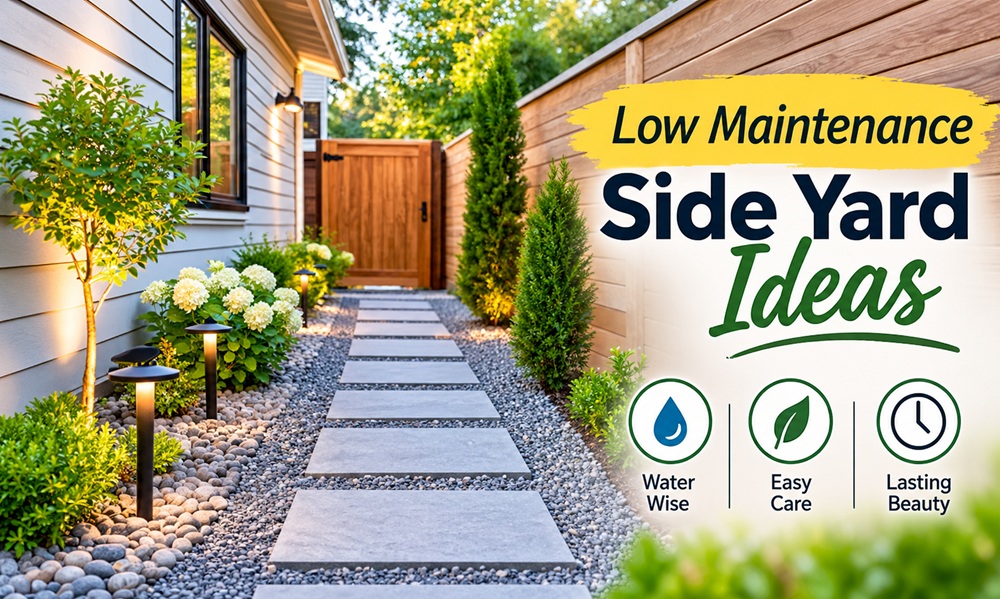
The side yard is usually the space nobody planned. It’s too narrow for a lawn, too shaded for many flowers, and it ends up holding trash bins, hoses, and whatever else didn’t fit in the garage. A handful of low maintenance side yard ideas can change that, and most of them come down to one principle. Cover the ground with something that never needs mowing, then add only as many plants as you’re willing to look after.
Decide what the strip has to do
Before choosing materials, list the jobs this space already does. Many side yards carry the walking route between the front and back, house a gas or electric meter that a utility worker must reach, store bins or firewood, and move rainwater away from the foundation. Each of those jobs sets a limit. A meter needs a clear approach. A gate needs room to swing. A downspout needs somewhere for water to go.
Once those are marked, the leftover space is yours to design. Often it works out as a path with a planting strip on one side, or a path that widens into a small sitting nook near the back.
Ground cover options compared
Grass is the high maintenance choice here because mowers barely fit and shade thins the turf. These are the surfaces that usually replace it.
| Surface | Works well for | Upkeep | Watch out for |
|---|---|---|---|
| Crushed stone or pea gravel | Paths and dry, sunny strips | Occasional raking and weed pulling | Drifting into beds, leaves collecting on top |
| Pavers or stepping stones | Walkways with a clear route | Very little once set on a firm base | Material cost and the labor of leveling |
| Shredded bark or wood mulch | Planting beds | Topping up about once a year | Washing away on slopes, breaking down in damp shade |
| Low groundcover plants | Shady, moist strips | Light trimming | Slow to fill in, and some spread too far |
| Artificial turf | Tiny strips where something green is wanted | Occasional rinsing and brushing | Heat in full sun, poor drainage over a weak base |
Whatever you choose, edging matters more than people expect. A simple steel or stone edge keeps gravel out of the beds and stops mulch from sliding onto the path. If you go with gravel, lay landscape fabric or a compacted base underneath, otherwise weeds tend to find their way up within a season or two.
Three simple layouts that work
A straight path with a bed on one side suits most strips. Set the path along the house side if you need clear access to windows and meters, and put the planting against the fence, where it can climb and soften the boundary.
A line of stepping stones through a gravel or groundcover bed works when the strip is very narrow. The stones carry the foot traffic and the surrounding surface needs no mowing, so the whole thing reads as a garden rather than a corridor.
For wider side yards, a path that jogs slightly and widens into a small pad gives you somewhere to put a chair or a pair of pots. The bend also hides the far end, which makes the space feel longer than it is.
Pick the layout before buying materials, because the shape affects how much of each one you need.
Plants that cope with tight, shaded, or windy conditions
Side yards behave differently from the rest of a property. A strip between two houses might get almost no direct sun, while one running along a south facing wall can bake in summer. Walk it at different times of day before you buy anything, because the light you assume is often not the light you have.
For shade, ferns, hostas, hellebores, epimedium, and sweet woodruff tend to be reliable, and they fill space without constant pruning. For hot, dry strips, sedum, lavender, ornamental grasses, and many native prairie plants tolerate poor soil and need little water once established. Choose plants suited to your region, and ask a local nursery or extension office which ones hold up in your climate.
Narrow spaces also reward vertical thinking. A row of columnar evergreens, or a few climbers trained up a fence, adds greenery without using floor space. Stick with compact growers and avoid anything with an aggressive spreading habit, because in a tight strip a vigorous plant turns into a weekly pruning job.
A drip line or soaker hose along the planting bed cuts watering down to almost nothing, and adding a simple timer makes it fully hands off.
Sort out the water first
Drainage isn’t glamorous, but a wet side yard will never be low maintenance. Check that the ground slopes away from the foundation and that downspouts discharge well beyond it. If water pools, a dry creek bed lined with river stones can guide it toward the street or a lower part of the yard. For persistent problems, a buried drain line is worth discussing with a landscape contractor.
Standing water also breeds mosquitoes and rots wood, so it pays to deal with it before laying any path. Laying pavers over a soggy base only means doing the job twice.
Make it useful without creating chores
A few practical touches keep the space working. A slim storage bench or a lattice screen can hide bins. One or two low voltage lights make the route safer after dark. If you’d like a small retreat, a single bench or bistro chair at the far end gives the strip a destination, and it asks for nothing more than an occasional wipe down.
Avoid features that need regular attention, such as a water feature with a pump or a dense mix of flowering annuals. Those belong in a yard where you actually sit every day, not in a strip you walk through on the way to the garden.
A narrow raised bed along the fence line can work if you want some herbs or a few vegetables, but treat it as the one high effort element and keep everything else simple. Placing it near a hose bib makes the watering much less of a chore.
Handling privacy and noise
Side yards often sit close to a neighbor’s windows. A fence topped with a lattice panel, a line of slim evergreens, or tall ornamental grasses can add privacy without a heavy build. Gravel underfoot tends to be noisy, so if the path is used at night, pavers or compacted fines are quieter choices.
Mind the property line and any local height rules before building anything tall, since fence and hedge limits vary from place to place.
A realistic upkeep routine
Even a well designed side yard needs a little care. In spring, clear fallen leaves and confirm the drainage still flows. Add a thin layer of mulch or rake the gravel level. In summer, pull the odd weed and check the drip line. In fall, clear leaves again, particularly from gravel, where they break down and feed weed seeds. That adds up to two or three short sessions a year, which is the honest meaning of low maintenance.
Start with the surface
If you only change one thing, replace patchy grass with a defined path and a clean edge. Everything else can come later, one plant or one feature at a time, and the strip will already look like someone planned it.
