

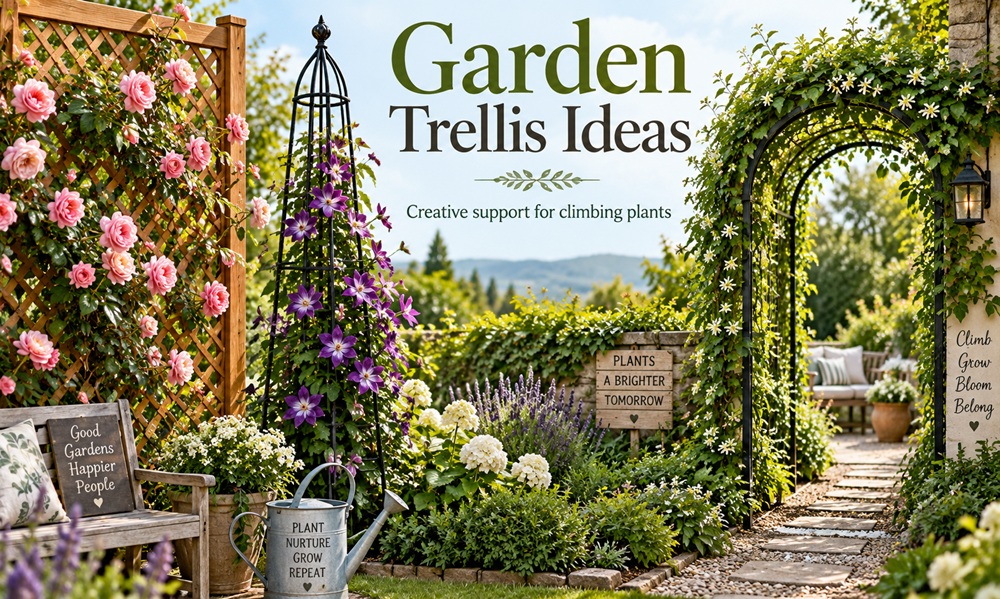
A trellis is one of the cheapest ways to make a garden feel taller and more finished. It lifts plants off the ground, creates screening and shade, and gives a flat bed some shape. The garden trellis ideas below range from a weekend project with a few bamboo canes to more permanent builds, so there’s a starting point for most budgets and skill levels.
Lattice panels on a fence
The simplest idea is often the best. Fix a wood or vinyl lattice panel to the top or face of an existing fence, and you’ve got instant support for climbing roses, clematis, or honeysuckle. Raising the panel a few inches off the boards with spacers keeps air moving behind the foliage. Topping a fence with lattice also adds height for privacy without needing a taller fence, which is handy where local rules limit fence height.
A freestanding panel as a garden divider
A trellis doesn’t need a wall behind it. A sturdy panel set on two posts can separate a vegetable patch from a seating area, hide a compost bin, or create a “room” in a larger yard. Because it stands alone, it catches wind, so sink the posts deep and brace the base. Planted on both sides, it looks good from every angle.
Obelisks in beds and pots
An obelisk is a tapered, four sided frame that gives vertical punch in a small footprint. Placed in the middle of a perennial bed, it breaks up a flat skyline and gives sweet peas or clematis somewhere to go. A smaller version in a large container suits a patio where there’s no ground to plant into. Metal obelisks look sharp and last, while willow or bamboo versions give a softer, cottage feel.
Bamboo teepees for beans and peas
For a quick vegetable garden win, push five or six long bamboo canes into the ground in a circle, lean them together at the top, and tie them firmly with twine. Plant a bean or pea at the base of each cane and they’ll scramble upward on their own. It’s cheap, takes minutes, and can be taken apart at the end of the season. Sturdy tying at the crossing point matters, because a full crop of beans gets heavy.
A-frame supports for cucumbers and squash
Two hinged panels propped into a triangle make a stable support that doesn’t need deep footings. Plant along both sides and the vines climb up and over, with fruit hanging inside where it’s easy to reach. The space underneath stays shaded, which suits lettuce and other greens that dislike summer heat. When the season ends, fold it flat and store it for next year.
Arched tunnels from cattle panels
Gardeners who grow squash, cucumbers, or small melons often turn to cattle or livestock panels. Bent into an arch and anchored with stakes or posts at each end, a panel makes a walk through tunnel with fruit hanging overhead where it’s easy to pick. The wire is stiff enough to carry heavy vines, and growing upward keeps fruit cleaner and helps air reach the leaves. You’ll want a helper to bend the panel and a plan for how to cut it to length.
Wire grids on a wall
If a wall is blank and you want greenery without a bulky frame, a grid of horizontal wires on standoff screws is hard to beat. Stainless steel wire or cable looks neat, and the plant appears to climb the wall itself. This setup suits espaliered fruit trees, climbing roses, and jasmine. Fix the anchors into solid masonry or framing, and keep the wires taut with turnbuckles so they don’t sag as the plant gets heavier.
A trellis planter for balconies and patios
A narrow planter box with a trellis attached is a small space solution that does two jobs. It grows a climbing plant and acts as a privacy screen between a seating area and the neighbors. Choose a box deep enough for the roots to stay cool and moist, and line it with good drainage. Annual vines like black eyed Susan vine or morning glory give fast cover, while a potted clematis offers something longer lasting.
Salvaged and repurposed supports
Old materials can make unusual trellises. An unused wooden ladder leaned against a wall, a metal bed frame stood upright, window frames, or branches lashed into a fan shape all work well, as long as they’re sturdy and clean. These ideas suit a relaxed, cottage style garden and cost almost nothing. Check wood for rot and metal for flaking paint before using it, and avoid anything that has been treated with chemicals you can’t identify near edible plants.
Arbors and archways
An arch over a path or gate creates a threshold, and it gives the garden a clear change of scene. Roses and clematis are classic choices, and heavier vines such as wisteria need a seriously strong build. Make the opening wide enough to walk through comfortably, including with a wheelbarrow, and keep thorny plants trained back from the path. Set the legs deep or into footings, since an arch loaded with growth catches a lot of wind.
Choosing between them
Start with the plant, then look at the space. A heavy perennial vine needs a strong, permanent structure like a wall grid or a solid panel. Annual vegetables are happy on a teepee or a cattle panel arch. Tight spots lean toward obelisks and trellis planters.
Think about how the trellis looks in winter too. Plants that die back leave the structure bare for months, so a handsome frame in good proportions earns its place all year. Budget matters, but a trellis that fails after a season costs more in the long run than one built to last.
Where a trellis earns its place
Some spots benefit more than others. A bare wall facing the patio gains softness from climbers, and the foliage also cools the surface a little in summer. A trellis at the end of a path gives the eye a destination and makes a short garden feel longer. Placed along the south or west side of a seating area, it can filter harsh afternoon sun without blocking the breeze. In a vegetable plot, put tall supports on the north side of the bed so they don’t shade the crops growing in front of them.
Practical tips for building your own
Use rot resistant wood such as cedar, or treat and seal ordinary lumber before planting, because it’s much harder to do afterward. Choose exterior screws or galvanized fasteners and pre-drill the holes so the wood doesn’t split. Keep the supports slim for tendril climbers and leave gaps wide enough for stems to pass through. Anything freestanding needs a solid base, either buried posts or stakes driven well into the ground. Finally, build a bit taller than you think you need, since most climbers keep going.
Try one in a spot that bothers you
Look around the garden for the dullest corner, the bare fence, or the bed that always looks flat. That’s usually where a trellis pays off fastest. Pick one of these ideas, match it to a plant you like, and give it a season to fill out.
