

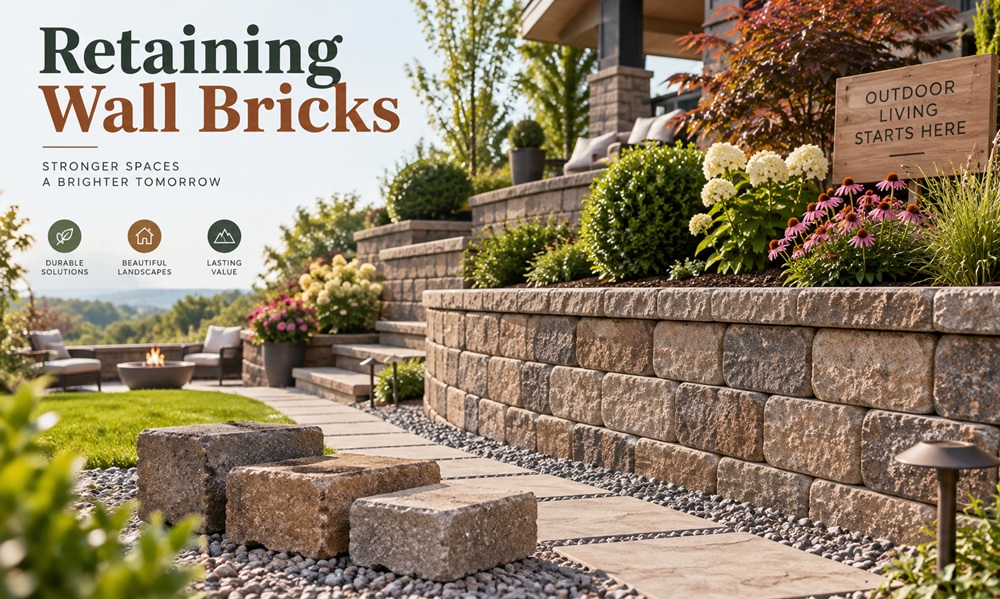
The best retaining wall bricks for most projects are not the standard bricks used on house walls. For a wall that holds back soil, you want dense, low absorption engineering bricks, or purpose made concrete retaining wall blocks designed to interlock and handle ground pressure. Ordinary facing brick can work in a low garden wall that retains only a small amount of soil, but it’s a gamble in wet or freezing climates. The right choice depends on how tall the wall is, how much soil it holds, and what the weather does to it each year.
Why ordinary house bricks struggle
A retaining wall lives in a harsher environment than a house wall. One face is pressed against damp soil, the top is exposed to rain, and in cold regions water that soaks into the brick freezes and expands. Standard facing bricks are made to look good and sit above ground in a sheltered position. Many absorb a fair amount of water, and over several winters the surface can flake away in a process called spalling.
Mortar joints are the other weak point. A wall with soil behind it is constantly pushed forward and kept damp from behind, which stresses joints and encourages efflorescence, the white salt deposits that appear on masonry. None of this means brick is a poor material. It means the type of brick, the mortar, and the way water leaves the wall all need more thought than they would for a garden border.
The main options
Concrete retaining wall blocks are the easiest route for a first time builder. They’re sold as systems, with a lip, pin, or interlocking shape that sets the backward lean and locks each course to the one below. They’re often called retaining wall bricks in everyday searches, and many have a split face finish that resembles stone. Because the system is tested and published by the manufacturer, you get installation guidance and height limits instead of guessing.
Engineering bricks are dense, strong, fired clay bricks with very low water absorption. They’re common in the UK and in other places where masonry has to survive wet ground, and they suit mortared walls and foundations. They have a plainer, darker look than many facing bricks, which can be a feature or a drawback depending on the garden. Sourcing varies by region, so ask a builders merchant what they stock and what the specification means.
Clay pavers and hard fired bricks are sometimes used for low walls around planting beds or terraces. Check that the product is rated for exterior and ground contact use, and that it can handle freezing if your area gets frost. A paver that works underfoot isn’t automatically right for a vertical wall.
Reclaimed bricks are tempting because they look wonderful, but quality is hard to judge. Old soft bricks can crumble quickly against wet soil. Use them for decorative caps or low walls with no retained soil, and save the load bearing work for something with known performance.
Mortared or dry stacked
Interlocking concrete blocks are normally dry stacked, which means no mortar between courses. Their strength comes from weight, the interlock, and the compacted gravel behind them. That flexibility is a benefit, because the wall can shift slightly with the ground without cracking.
Mortared brick walls act as a rigid mass. They need a proper concrete foundation below frost depth in cold regions, strong mortar, and often steel reinforcement for anything of real height. They also need weep holes or another drain route so water doesn’t build up behind the wall. A rigid wall that traps water will crack, bulge, or lean over time.
If you aren’t confident working with mortar, stick with a block system. If you love the look of brick and the wall is short, a mortared design is realistic, though it’s worth having a mason review the plan first.
How tall can a brick retaining wall be
There’s no single answer, because it depends on the bricks, how they’re laid, the soil, and any loads above. Small garden walls of roughly knee to waist height are often manageable for experienced DIYers, particularly in block systems. Walls that are taller than the manufacturer’s stated limit, that carry a driveway, building, or slope above, or that hold back clay or waterlogged soil usually need an engineer’s design.
Many local authorities require a permit above a set height, and the limit differs by location. Contact your building department before you buy materials, not after.
What to check before you buy
Ask the supplier a few direct questions and look at the product data sheet.
- Is the brick or block rated for exterior use and ground contact?
- Does it resist freeze and thaw cycles in your climate?
- What is the maximum wall height for the product without reinforcement or an engineer?
- Does the system include capstones, corner units, and curved options?
- Are the dimensions consistent between batches, since uneven units make it harder to keep the courses level?
Order a sample if you can, and look at it in daylight next to your house or paving. Colors can shift between photos and real life.
Working out how many you need
For a rough count, measure the wall length and planned height, multiply to get the face area, and divide by the face area of one brick or block. Add a small allowance for cuts, breakage, and corners. For block systems, remember that the courses below ground count too, and that capstones are ordered separately.
Cost depends on the material, the region, delivery distance, and how much base stone, drainage gravel, and pipe the job needs. Don’t judge a quote only by the price of the bricks. The base and drainage materials often add up to more than people expect, and they protect the investment.
Foundation and drainage come first
Whatever you choose, the bricks are only the visible part. A compacted gravel base, or a concrete footing for mortared walls, keeps the wall from settling. Drainage gravel behind the wall and a way for water to escape stops pressure building up. Without those, even the best bricks will move.
Choosing the finish
Once the structure is sound, the look is yours. Earth tones and soft grays blend into most gardens, while a brick that echoes the house walls can tie the yard and building together. Textured faces hide dirt and minor weathering better than very smooth ones. A solid capstone gives a clean top edge, sheds water, and gives people somewhere to sit, so it’s worth getting right.
Planting along the top and base softens a hard wall. Choose plants with modest root systems near the base, and avoid large trees close to the wall because their roots can push against it.
Mistakes to avoid
- Buying decorative bricks without checking they suit ground contact
- Skipping the footing or base to save time
- Using the excavated soil as backfill instead of free draining gravel
- Building higher than the product allows
- Forgetting the drain outlet
Most failures trace back to one of those, rather than to the bricks themselves.
Start with the wall, not the brick
Decide the height, the soil conditions, and who will build it before you fall for a particular look. A short wall in a mild climate gives you plenty of choice. A taller wall in a wet or freezing area narrows the options to engineered products, and that’s a good thing. Pick the system that suits the job, then enjoy choosing the color.
