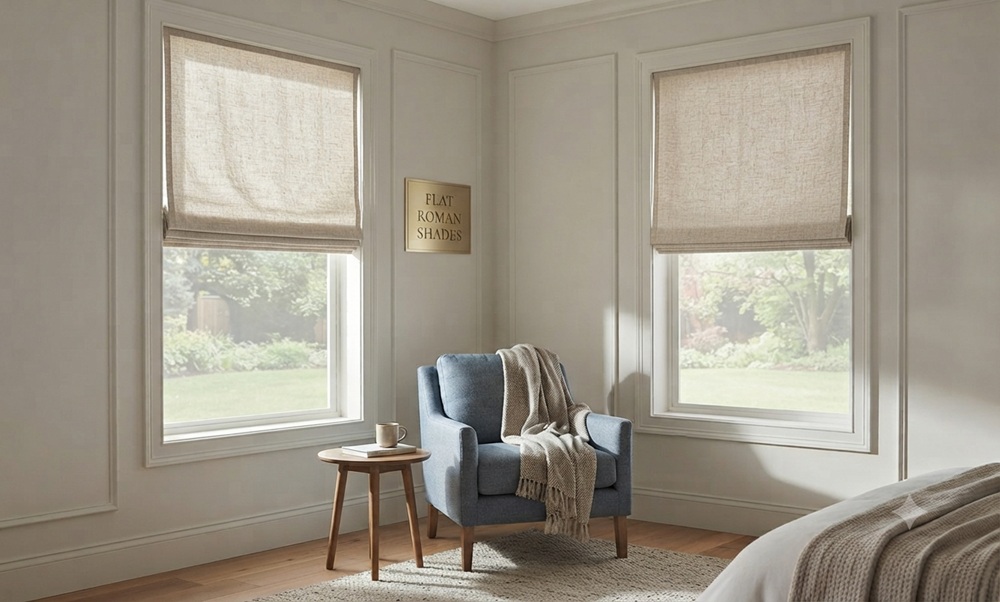
A flat roman shade is a fabric window covering that hangs as a smooth, uncreased panel when lowered and stacks into folds only when you raise it. The clean face is the whole point. With no permanent pleats or soft curves, the fabric looks like a tailored piece of cloth stretched across the window, which suits modern, transitional, and tailored traditional rooms.
If you’re comparing flat styles with other roman shades, the key question is how much structure and softness you want when the shade is down. The sections below cover how flat shades work, where they look best, and how to measure and install one without costly mistakes.
How a Flat Shade Works
Horizontal rods or battens sewn into pockets at the back of the fabric hold it straight, and cords threaded through rings guide the folds upward. When the shade is lowered, those rods keep the panel flat. When you raise it, each rod meets the one above, and the fabric stacks in even bands.
Because the fabric stays taut, it shows off pattern and color better than softer styles do. It also leaves no room to hide sloppy measuring, since a panel that’s too narrow or hanging crooked is easy to see.
Flat Compared With Other Roman Styles
| Style | Look when lowered | Best suited to |
|---|---|---|
| Flat | Smooth, uncreased panel | Modern or tailored rooms and bold patterns |
| Relaxed | Soft curve at the bottom, gentle fall | Casual and traditional rooms |
| Hobbled | Overlapping folds visible even when down | Cozy, classic spaces |
Flat shades read as crisp and architectural. Relaxed shades feel softer and forgiving, which is handy if the fabric is light or the window isn’t perfectly square. Hobbled shades add visual layers and a classic look, but they break up patterns more than a flat panel does.
Where Flat Roman Shades Work Best
Home offices, kitchens, bedrooms, and dining rooms all suit the style, particularly where the window trim is clean and the surrounding decor leans toward simple lines. Bay windows and a series of matching windows look especially good, because identical flat panels create a calm, repeated rhythm.
They’re less forgiving on very wide windows. A single wide panel can sag or show rod lines if it isn’t supported properly, so a large opening is usually better split into two or three shades side by side. Ask the maker about maximum recommended widths for the fabric you’ve chosen.
Choosing Fabric for a Flat Shade
Medium weight woven fabrics hold flat best. Very thin cloth can ripple or show the rod pockets, while very heavy cloth adds bulk and stacks tall when raised. A tight weave with some body keeps the surface smooth and gives a sharper look.
Patterns benefit from flat styling. Stripes, geometric prints, and bold solids stay intact instead of being broken up by constant folds. If you choose stripes, ask whether the maker aligns them across multiple shades, since mismatched lines are very visible on flat panels.
Lining matters as well. A standard lining adds structure and protects the face fabric, while blackout lining suits bedrooms and keeps the panel looking even from outside the house.
Measuring and Installing Step by Step
- Decide whether you want an inside mount within the window frame or an outside mount on the wall or trim.
- For an inside mount, measure the width at the top, middle, and bottom, and use the narrowest number.
- Measure the height at the left, center, and right, and follow your supplier’s guidance on which figure to use.
- Check the depth of the window recess to be sure the headrail will fit and sit clear of the glass.
- Mark bracket positions with a level, and keep them aligned so the shade hangs straight.
- Fasten brackets into solid framing or use anchors rated for the weight, especially for lined or heavy shades.
- Hang the headrail, test the lift several times, and adjust the cords or levelling until the panel rests evenly.
Style Choices That Change the Look
Small details shift a flat shade from plain to polished. A contrasting border or banding along the edges adds definition. A shaped or tailored bottom hem gives a more custom feel. A valance or cornice can hide the headrail and add a decorative top, though many modern rooms look better without one.
Color placement matters too. A shade in the same tone as the walls blends in quietly, while a bold hue turns the window into a focal point. Consider how the shade will look from outside as well, since the lining color is what neighbors and passersby will see.
Light Control and Privacy
How much light a flat shade lets through depends on fabric and lining. A light filtering weave glows when the sun hits it and can show silhouettes at night when lamps are on inside. Add a standard lining and privacy improves, though some daylight still passes through. Blackout lining blocks most light and is the best option for bedrooms, but it also makes the shade feel heavier and may stack a little taller.
Some people layer a light filtering shade with a second blackout shade, which allows flexibility between day and night. It’s more hardware and a higher cost, so it’s worth deciding whether you really need that level of control.
Pairing Flat Shades With Room Styles
In a modern room, a solid flat shade in a quiet neutral supports the clean lines of furniture and architecture. Transitional spaces can handle a subtle texture or a tone on tone stripe. Traditional rooms look polished with a flat shade in a classic pattern, especially when the trim is substantial and the shade sits inside the frame.
Cottage or farmhouse spaces can work with flat shades too, but a softer fabric such as linen or a linen blend keeps the look from feeling too severe. Whatever the style, consider the other fabrics in the room so the shade complements instead of competing.
Cleaning and Care
Flat shades are easy to maintain when you stay on top of dust. Lightly brush or vacuum them using a soft attachment, working from top to bottom. Spot clean only when the fabric allows it, test a hidden corner first, and avoid saturating the panel, since moisture can distort the lining or the rod pockets. Raise and lower the shade fully from time to time so the folds don’t settle in one position.
Safety and Cordless Options
Cords can be hazardous around young children and pets, so cordless systems are the safer choice for homes with either. Cordless flat shades lift with a gentle pull on the bottom rail, which also keeps the front of the shade clean. Motorized versions suit tall windows and hard to reach spots. If you do choose a corded shade, follow the maker’s safety instructions and keep cords well out of reach.
Mistakes to Avoid
- Measuring once and ordering immediately, instead of checking each dimension at several points
- Choosing a fabric that’s too thin, which can ripple or show the rods
- Ignoring stack height, which can block part of the view when the shade is raised
- Skipping lining on a sunny window and exposing the face fabric to fading
- Using one very wide shade where two or three would hang better
Final Thought
Flat shades reward precision. Accurate measurements, a well chosen fabric, and solid mounting do more for the finished look than any decorative extra. Get those right, and the clean lines will do the rest.