

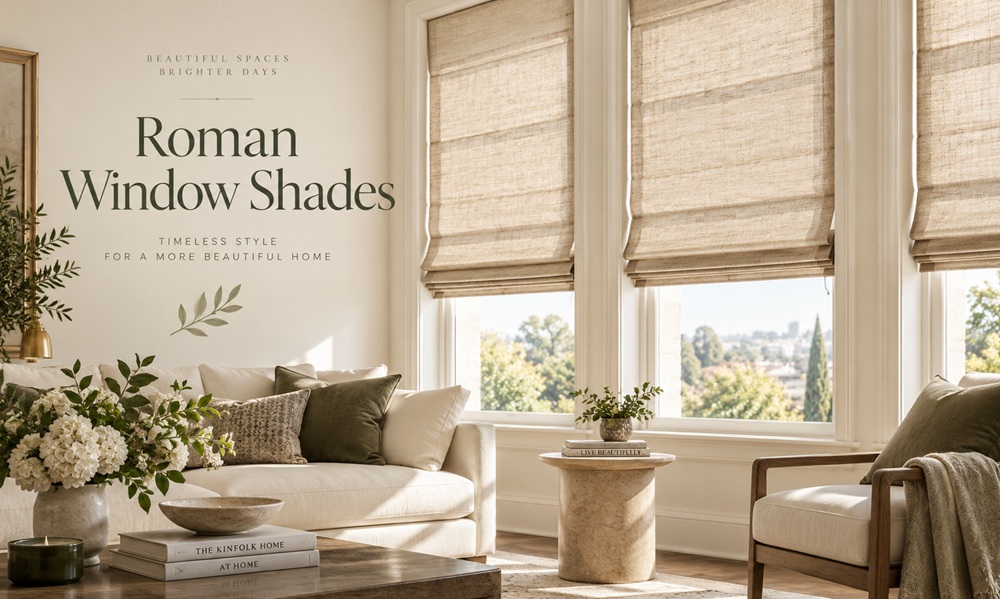
Roman window shades are fabric shades that stack into neat horizontal folds when you raise them and hang flat and smooth when you lower them. They sit somewhere between a curtain and a blind. You get the softness, color, and pattern of fabric, along with the tidy control of a shade that fits right inside a window frame or just above it.
They work well in kitchens, bedrooms, home offices, and living rooms, and they’re especially handy on windows where long drapery would get in the way, like over a sink or beside a desk. Choosing the right pair comes down to four decisions. You need to pick a fold style, a fabric, a lining, and a lift system. Get those four right and the rest is mostly measuring.
The Main Styles of Roman Shades
The style changes how the shade looks both open and closed, so it’s worth settling this before you fall for a fabric swatch.
Flat Roman Shades
Flat shades, sometimes called tailored shades, lie completely smooth when lowered, like a fabric panel. They fold into even pleats only when raised. Because the fabric stays uninterrupted, they show off bold prints and stripes better than any other style.
Relaxed Roman Shades
Relaxed shades have a softer look. The fabric sags gently between each fold, even when the shade is down, which gives the window a casual, slightly rumpled feel. They pair nicely with linen and are a natural fit for farmhouse and coastal rooms.
Hobbled Roman Shades
Hobbled shades, often called waterfall shades, keep their folds visible at all times. The layers cascade down the window like a stack of soft cushions. They use more fabric, so they tend to look fuller and more formal, and they hide a plain fabric’s flatness well.
Balloon and Austrian Styles
These are puffier and more decorative, with scalloped or gathered bottoms. They suit traditional rooms, but they’re less common now because the clean look of flat and relaxed styles fits most modern homes better.
| Style | Look when lowered | Best suited to |
|---|---|---|
| Flat | Smooth and tailored | Patterned fabric, modern rooms |
| Relaxed | Soft, gently draped | Linen, casual spaces |
| Hobbled | Layered folds throughout | Formal rooms, plain fabrics |
| Balloon | Gathered and puffed | Traditional decor |
Fabric Choices That Actually Matter
The fabric controls the mood of the room, the amount of light that gets through, and how much upkeep the shade needs.
Linen and linen blends bring texture and a relaxed look, and they let in a warm, filtered glow. They wrinkle a little, which most people like in linen and some people don’t. Cotton comes in the widest range of prints and colors, though it can fade in strong sun if it’s unlined. Polyester and other synthetic blends hold their shape, resist wrinkling, and clean more easily, so they’re a sensible pick for busy rooms. Woven wood and bamboo add natural texture and handle humidity better than many fabrics, but they usually let more light and visibility through unless they’re lined.
Heavier fabrics such as velvet or thick cotton drape beautifully and feel substantial. They also tend to work better with a thermal or blackout lining when you want to limit drafts and glare.
Light Control and Privacy
Most roman shades come in three light levels, and the lining is what sets them apart.
- Light filtering shades soften daylight but let a good amount through. At night, with lights on indoors, people outside may see silhouettes.
- Room darkening shades use a lining that blocks most light, which suits living rooms and offices where glare on a screen is a problem.
- Blackout shades use an opaque lining for the darkest result, which is the usual pick for bedrooms and nurseries.
A lining also protects the face fabric from sun damage, so it’s worth considering even in rooms where darkness isn’t the goal. Keep in mind that light can still slip around the edges of an inside mounted shade. If you want the room truly dark, an outside mount that overlaps the frame will do more than a lining alone.
Inside Mount or Outside Mount
An inside mount sits within the window frame. It looks clean and shows off your trim, but the frame needs enough depth to hold the shade, and the window has to be reasonably square. Small gaps along the sides are normal.
An outside mount attaches to the wall or trim above and around the window. It hides uneven frames, blocks more light, and can make a small window look larger when the shade extends a few inches past each side. The tradeoff is that the shade covers your trim.
How to Measure for Roman Shades
Measure with a steel tape rather than a cloth one, and write everything down as you go.
- For an inside mount, measure the width inside the frame at the top, middle, and bottom. Use the narrowest number.
- Measure the height on the left, center, and right sides. Use the longest number for a clean drop.
- Check the frame depth against the shade’s mounting requirements, which the manufacturer lists.
- For an outside mount, decide how far you want the shade to extend past the window on each side, then add that to your window width. Add height above the frame if you want the shade to cover the trim.
- Record width first and height second, since most retailers ask for them in that order.
Some makers subtract a small allowance from inside mount measurements automatically, and others expect you to do it. Read their instructions before you submit anything.
Lift Systems and Child Safety
How the shade moves matters more than people expect, and it affects safety.
Corded shades use a pull cord that locks in place. Continuous loop systems use a looped cord or chain on one side. Cordless shades lift by hand, usually by pulling the bottom rail. Motorized shades run from a remote, a wall switch, or a smart home app.
Loose cords are a strangulation hazard for young children and pets, and safety organizations recommend cordless or otherwise inaccessible cords in homes where small children spend time. Cordless works well for most windows, though very wide or tall shades can be heavy to lift by hand. For those, and for windows you can’t easily reach, a motorized system is often worth the extra cost.
Where Roman Shades Work Best
Kitchens do well with washable synthetic blends, as long as the shade isn’t hanging right over a stove. Bedrooms benefit from blackout linings. Home offices like light filtering styles that cut glare without turning the room into a cave.
Bathrooms need more thought. Steam and splashes can damage natural fabrics and the shade’s cords, so a moisture resistant fabric and a spot away from the shower spray make a big difference.
One quirk catches many buyers. When raised, a roman shade stacks at the top of the window, and that stack can cover several inches of glass. Mounting the shade a few inches above the frame, or choosing a style with a shallow stack, keeps more of your view when the shade is up.
Care and Cleaning
Dust the shade regularly with a soft brush or the brush attachment on a vacuum, using low suction. For marks, blot gently with a damp cloth and mild soap, and test a hidden corner first. Avoid soaking the shade, because the lining, rings, and internal rods don’t always react well to water. Delicate fabrics like silk or linen with a special finish are better left to a professional cleaner. Always follow the manufacturer’s care label, since fabrics and construction vary widely.
Mistakes Worth Avoiding
A large pattern on a narrow window often gets cut off awkwardly, so check how the print will fall on your actual width. Skipping the lining saves money at first and costs more when sun fades the fabric. Measuring once instead of three times leads to shades that bind or leave visible gaps. And choosing a relaxed style for a formal dining room, or a hobbled style for a tiny casual kitchen, usually leaves the room feeling a little off.
Picking the Pair You’ll Still Like in Five Years
The best roman window shades are the ones that suit the room’s daily habits. Start with the light you need and the safety you want, choose a fold style that fits the character of the space, and let the fabric come last. A well measured, well lined shade in a fabric you genuinely like will outlast a trend, and it’ll look good both open and closed.
